
Metabolic Architecture: Living Nodes as Bio-Digital Organs for Urban Agglomerations
Reading a building’s skin and a plaza’s smart furniture as functional organs — inhaling air and data, filtering both, exhaling something cleaner — instead of as a facade with sensors bolted on after the fact.
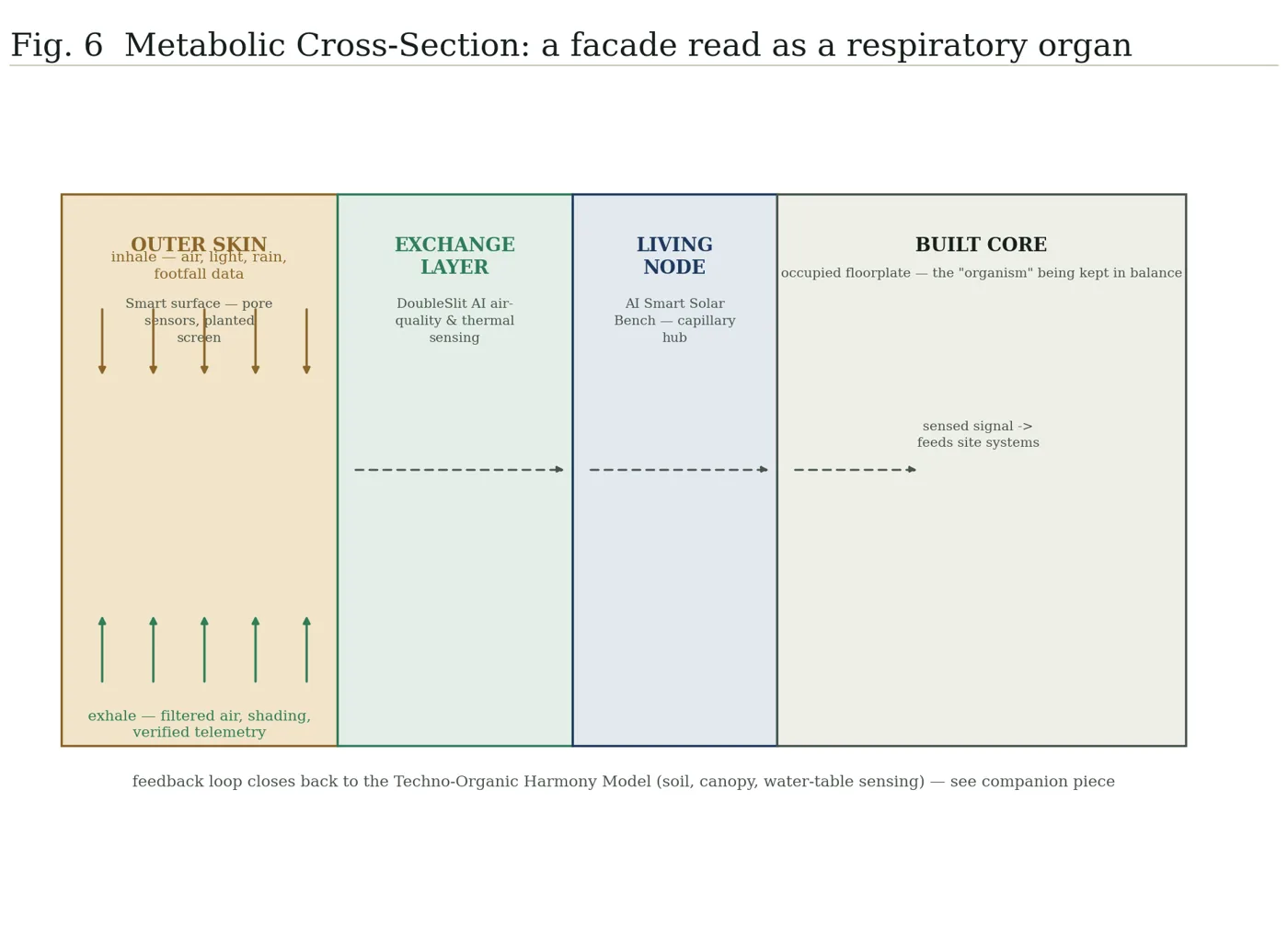
Fort-Gate Urbanism and the Honeycomb Resiliency Model describe a site as a network of cells and gates. Metabolic Architecture pushes that thinking one level down, into the building envelope itself, and asks a more literal question: if a facade is going to sense and respond to its environment anyway, what happens if it is designed like an organ rather than a wall with instruments attached to it?
The working analogy is respiration. An outer smart surface — a planted screen, a sensor-embedded skin, a permeable rain-screen — functions as the inhaling layer: it is where air, daylight, rainfall and footfall first meet the building, and where the first layer of filtration and shading happens, the same way a leaf’s stomata regulate what actually gets absorbed. Beneath it, an exchange layer of IoT sensing does the equivalent of gas exchange — reading air quality, temperature and humidity and converting that reading into an actionable signal rather than a static display. What is genuinely new is not the sensing itself, which the AI Smart Solar Bench network has been running for some time, but treating the sensing layer as a required organ of the building rather than an optional add-on to it.
A Living Node — in practice, a Smart Bench or an equivalent solar-battery hub placed in a plaza, courtyard or campus quad — functions as a capillary rather than a piece of furniture in this reading. It is where the metabolic signal from the skin and the exchange layer actually meets people: adaptive lighting, air-quality alerts, and charging or Wi-Fi access delivered at exactly the point of use, drawing on the same edge-controller backbone that runs smart-automation lighting and climate features indoors.
The loop closes on both ends. On the input side, a closed-loop water system — pumps, sensors and dosing controllers, each correcting for the other — is a working small-scale example of biological-mechanical symbiosis, closer to a digestive system than a piece of plant equipment. On the output side, sorting and recycling stations are the excretory half of the same organism — nothing leaves a site as unexamined waste, in the same way a healthy organ doesn’t simply discard what passes through it without extracting value first.
Where this changes an actual design brief is in sequencing. A conventional facade brief specifies cladding, glazing and shading, then adds sensors afterward if the budget allows. A Metabolic Architecture brief specifies the sensing and exchange layer at the same stage as the cladding, because the “inhale” and “exhale” functions have to be sized and positioned together — a shading strategy that blocks the sensors meant to be reading solar gain defeats its own purpose. It is the same logic already applied to the Landscape Architecture & Urban Parks Upgradation vertical’s native softscape planning, extended from the ground plane up to the building skin.
Read together with the planning papers, Metabolic Architecture adds one more layer to the reading of a site as a single organism: how the building breathes, how it stays in balance with the biology around it, and how nothing leaves it uncounted.
Part of the ArthAxis Research Lab. Builds on R-01: ArthAxis Planning Theory. Read the citation →
More from ArthAxis Research Lab
ArthAxis Planning Theory
The internal framework behind every ArthAxis master plan — one spatial pattern, read at every scale from a nation down to a single courtyard.
R-02 · 7 MINFort-Gate Urbanism
A defensive fort-and-gate settlement pattern, translated into a hexagonal "honeycomb" topology — so a city or campus has more than one way to keep functioning when a single route fails.
R-05 · 7 MINThe Honeycomb Resiliency Model
Fort-Gate Urbanism made the qualitative case for a six-gate hexagonal layout. This piece scores it — a numeric Honeycomb Resiliency Index that turns “more gates, more paths” into an auditable number, with each gate tied to a named accountable owner.